A functioning garden relies less on the number of equipment and more on their suitability for the terrain, exposure, and actual uses. We regularly observe setups overloaded with decorative furniture but lacking basic technical solutions: water management, compliant lighting, and structured storage. Here are the priority areas to address for a truly usable garden.
Outdoor lighting: the regulatory constraint of 3,000 K to be integrated from the design stage
Since January 1, 2025, outdoor lighting installations must comply with a maximum limit of warm white at 3,000 K. In sensitive areas or near astronomical sites, this threshold drops to 2,700 K, or even 2,400 K.
Globes or ball-type luminaires that diffuse light widely, sending more than half of the light above the horizontal, are gradually being banned. For co-ownerships, replacement must be effective by January 1, 2025.
The law of April 15, 2024, has also included the notion of abnormal neighborhood disturbance in the civil code. A poorly oriented or overly powerful spotlight now holds the owner liable, even without a proven fault, as long as the light causes a disturbance exceeding normal inconveniences (duration, intensity, orientation towards the neighboring facade).
We recommend prioritizing low bollards with beams directed towards the ground, recessed pathway lights, and wall sconces with limited flow. Well-designed garden lighting is not just about ambiance: it’s an area where choosing the wrong luminaire exposes one to sanctions and neighborhood disputes. For more information on ambiance-jardin.eu, the sheets detail the technical characteristics to check before purchase.
Rainwater harvesting: a garden equipment that has become structural
Sales of rainwater collectors have significantly increased in recent years, driven by repeated drought episodes and rising water prices. The equipment is no longer limited to a simple above-ground tank on the terrace.
Buried tanks and reservoir fences
Large-volume buried tanks, connected to gutters, allow for feeding a gravity or pressure irrigation network for the vegetable garden, flower beds, and lawn. The most notable recent innovation is the reservoir fence that stores rainwater within its structure, combining parcel delimitation and storage capacity without encroaching on the usable area of the garden.
Before investing, three criteria deserve serious analysis:
- The area of the collecting roof, which determines the annual recoverable volume and thus the sizing of the tank.
- The nature of the soil and the depth of the water table, to be checked if you opt for a buried tank.
- The connection to usage points (outdoor taps, drip irrigation, watering timer) to avoid passive storage that only serves to fill a watering can.
A properly sized collector significantly reduces the consumption of drinking water for the garden and is now a criterion for enhancing property value.
Garden shed and outdoor storage: usable space versus lost space
A garden shed is not just for storing the lawnmower. It structures all outdoor storage and frees up living space. We find that undersized sheds quickly become inaccessible clutter.
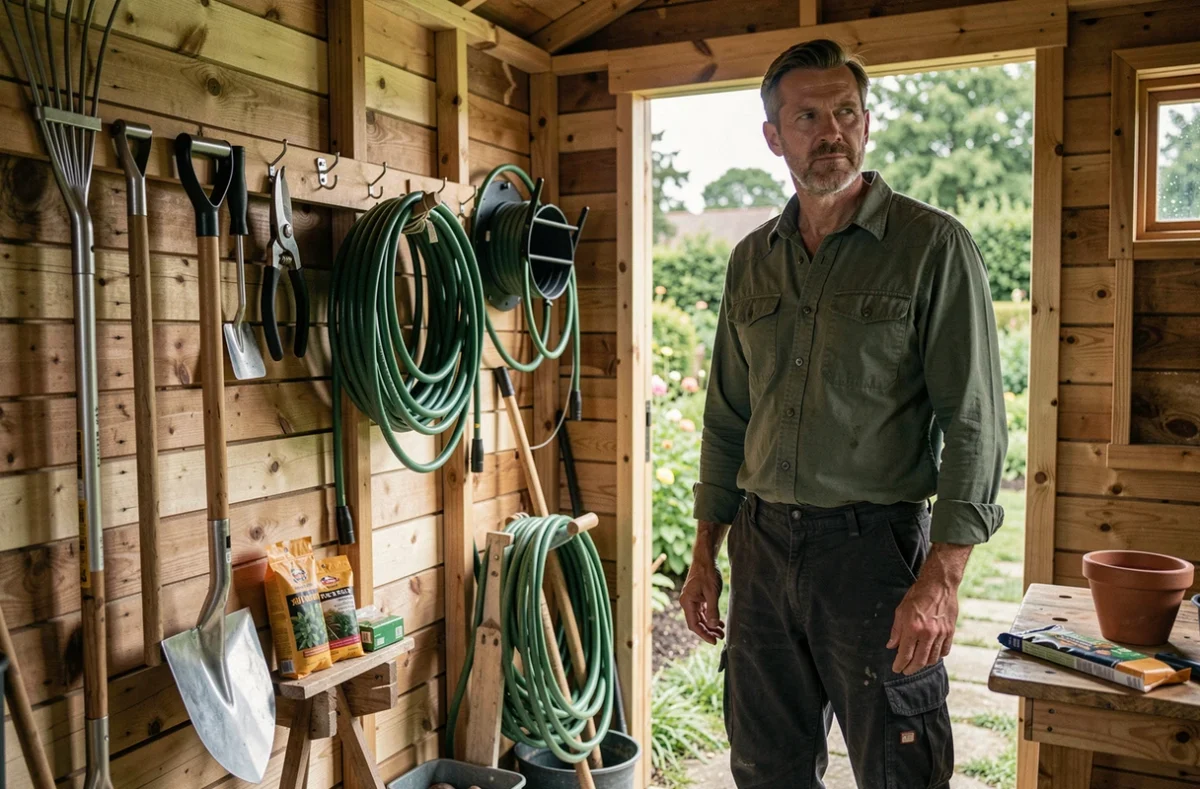
Plan for at least a linear wall equipped with shelves and hooks rather than just an empty volume. Vertical storage is the key to a functional shed: long tools suspended, stacked bins, modular shelves for products and small accessories.
Materials and placement
Pressure-treated wood remains the standard for quality sheds, but aluminum-resin composite structures are gaining ground due to their total lack of maintenance. The placement must take into account local regulations (preliminary declaration or building permit depending on the floor area) and orientation: a south-facing shed without ventilation becomes an oven in summer.
Garden furniture and sun protection: the technical trade-offs that matter
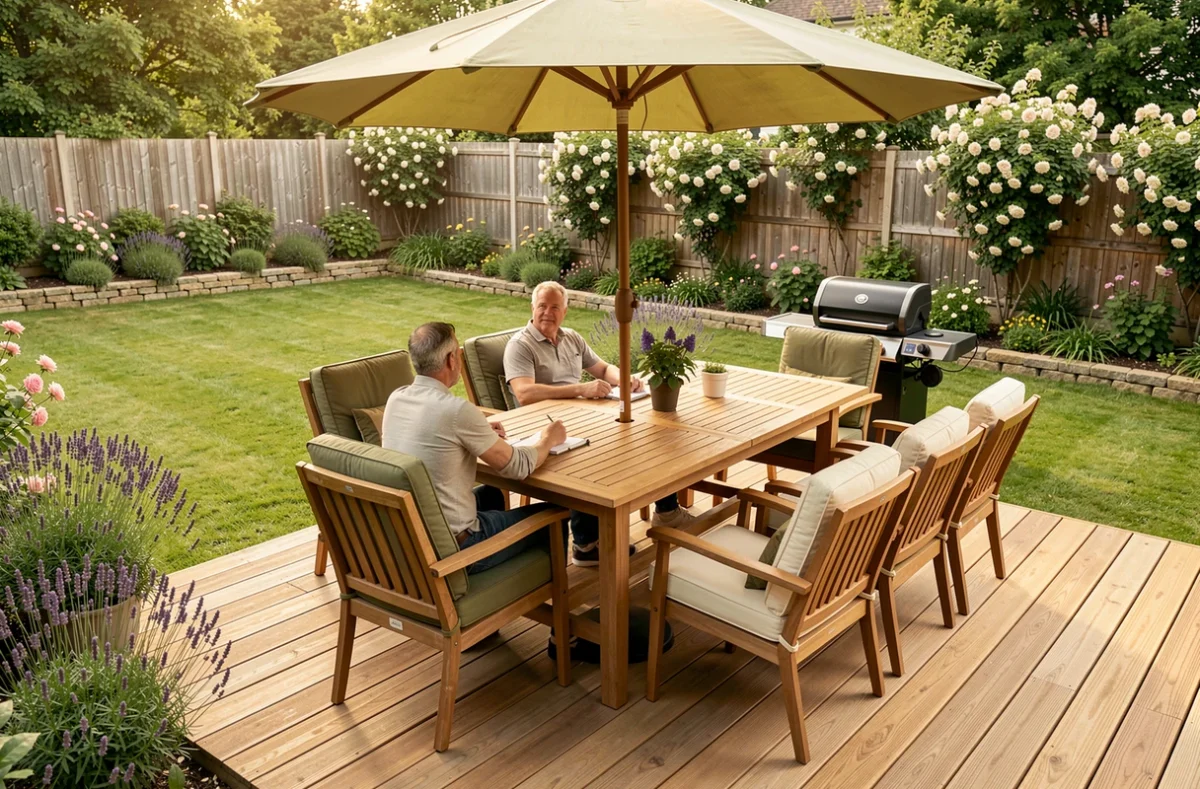
The choice of garden lounge affects the actual frequency of use of the outdoor space. Uncomfortable or too heavy furniture to move ends up staying under its cover.
Epoxy-treated aluminum offers the best weight-resistance ratio for daily use. Woven resin remains popular, but its durability heavily depends on the quality of the weaving and the internal structure (aluminum or steel frame). Terrace furniture without appropriate sun protection reduces the usage window to just a few hours a day in summer.
- The cantilever umbrella covers a larger area than a central umbrella and frees up space under the canopy but requires significant weighting to withstand the wind.
- The shade sail stretched between fixed points (wall, post, mature tree) creates a more extensive shaded area, provided that the anchors can support the tension and rain loads.
- The bioclimatic pergola with adjustable slats is the most sustainable investment, allowing for fine management of sunlight and ventilation, but represents a significantly higher budget.
Garden maintenance tools: invest in three areas rather than ten
Accumulating cheap tools is more expensive in the medium term than focusing on three durable pieces of equipment. For a medium-sized garden, we recommend concentrating the budget on mowing, pruning, and soil work.
A mower suitable for the area and slope of the terrain remains the priority purchase. Battery models have caught up with gas ones in autonomy for common areas. The ratchet pruner and ergonomic hedge shears cover most pruning needs without multiplying specialized tools.
For soil work in the vegetable garden, a broadfork effectively replaces a spade, fork, and tiller on reasonably sized plots, preserving soil structure.
A well-equipped garden is not one that has the most accessories, but one where each piece of equipment fulfills a specific function, compliant with current regulatory constraints and sized for the actual use of the land.