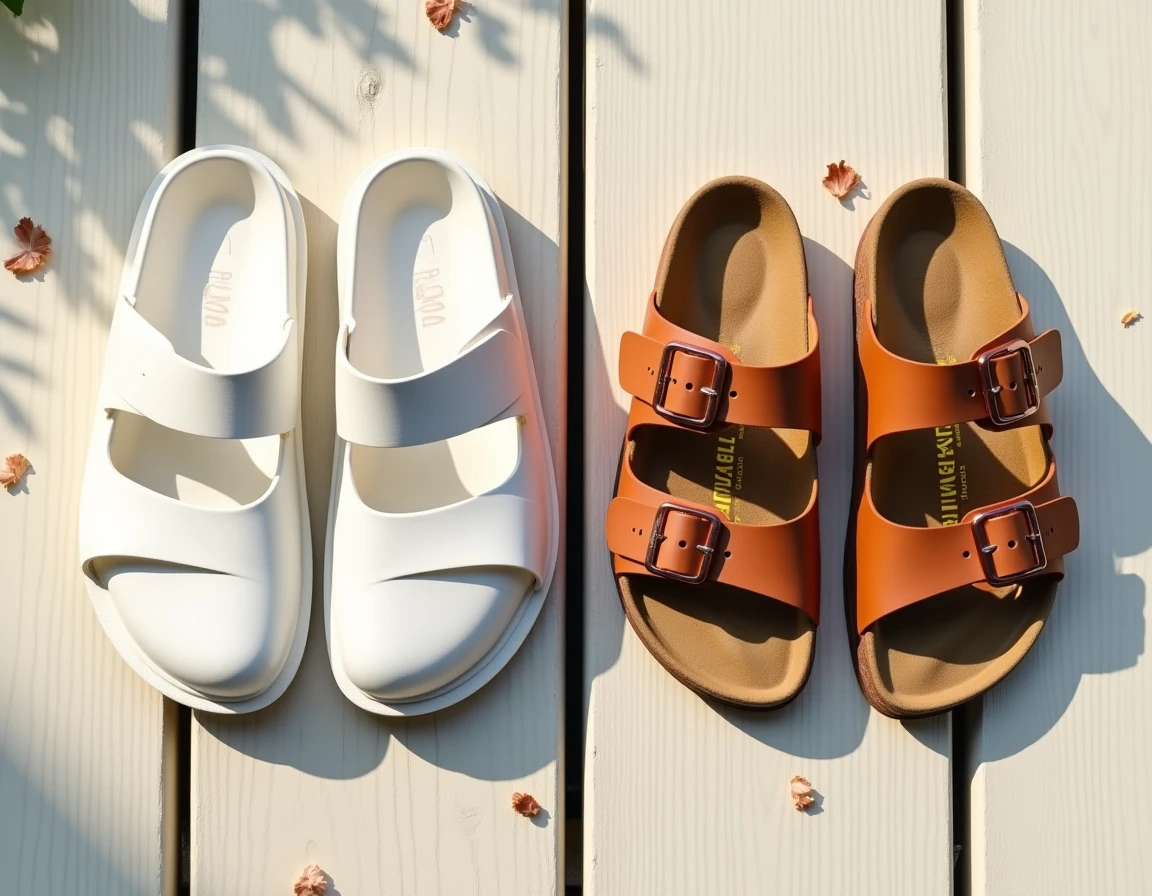
The cork-latex footbed of Birkenstock and the soft upper of Billowy do not operate in the same biomechanical realm. Comparing these two brands solely on price ignores what actually happens underfoot when the thermometer exceeds 30 °C.
Structured sole versus barefoot approach: two philosophies of footwear

Birkenstock builds its models around a cork and natural latex footbed molded on four support points: longitudinal arch, transverse arch, heel cup, and metatarsal bar. This architecture remains semi-rigid, even on the lighter EVA variations. The foot is held, guided, corrected.
Billowy takes an opposite approach. Recent models, often marketed as barefoot sandals, rely on a soft and flexible sole that follows the natural roll of the foot. The ground feel is direct, with almost no structure. For summer use focused on the beach, water days, or casual walking, this lightness changes the game.
A comparison of Billowy or Birkenstock focused solely on aesthetics overlooks this fundamental opposition: structured architecture on one side, joint freedom on the other.
We observe that the relative rigidity of Birkenstock cork limits the deformation of the sole under load, which stabilizes the foot but reduces airflow under the arch. The flexibility of Billowy, on the other hand, creates a slight play between the foot and the sole with each step, promoting a micro-flow of air. Over a full day in high heat, this difference is felt.
Breathability of sandals in summer: materials and foot ventilation
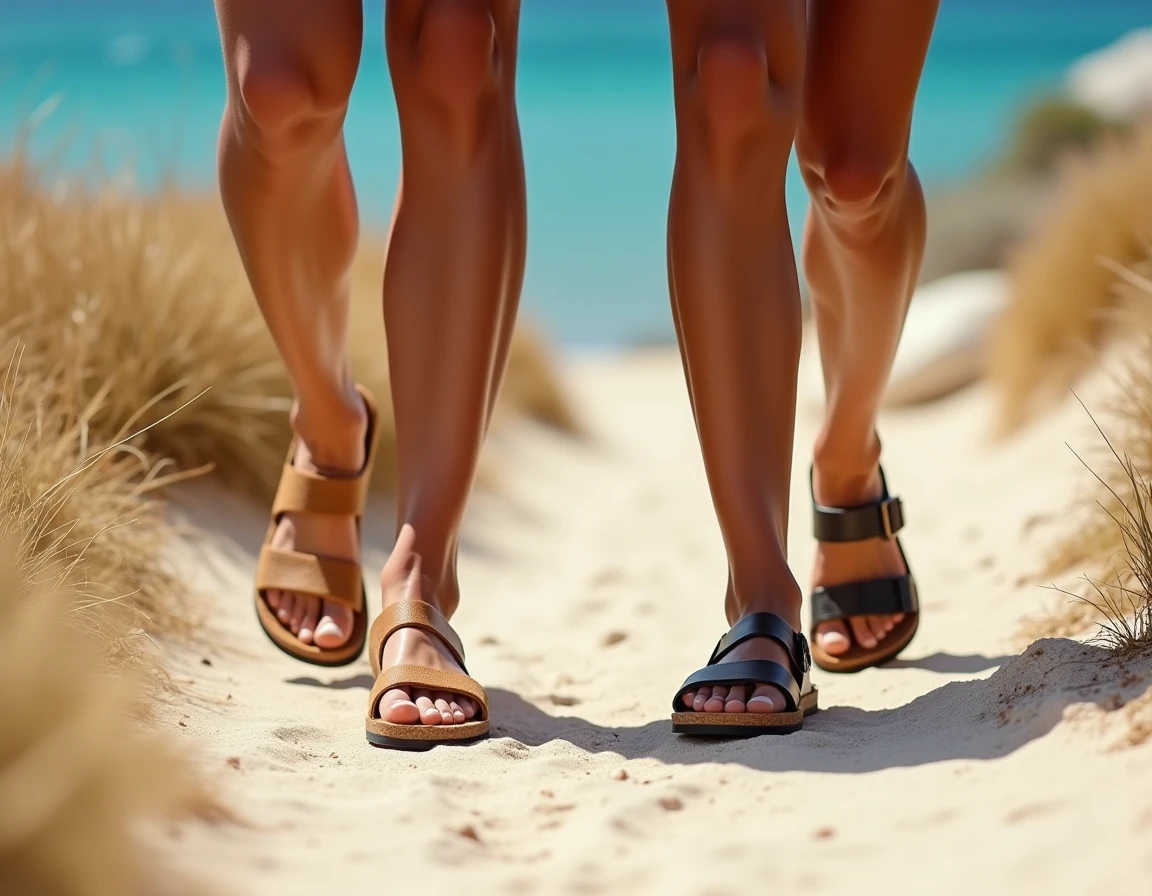
Cork partially absorbs moisture and regulates temperature upon contact with the skin. Birkenstock has been exploiting this property for decades. The leather or Birko-Flor of the straps allows for a decent airflow over the top of the foot, but the sole coverage remains dense.
Billowy uses lightweight synthetic materials and, on some models, very open uppers that widely expose the instep and toes. The downside: the lack of absorbent natural material means that sweat is not captured but simply evaporated. In dry weather, this is effective. In humid weather, the foot slips more.
Concrete ventilation criteria to check before purchase
- The contact surface between the sole and the foot: the smaller or more textured it is, the more air circulates. Billowy models with smooth soles stick more than those with micro-reliefs.
- The number and width of the straps: a Birkenstock Arizona sandal with two wide straps covers more surface than a Billowy model with thin straps, which reduces ventilation on the top of the foot.
- The material of the inner lining: the suede of Birkenstock absorbs sweat, while the synthetic finishes of Billowy dry faster after immersion but absorb nothing in dry conditions.
Birkenstock or Billowy: durability and longevity
Birkenstock cork can be resoled and refurbished. A skilled cobbler can replace the outsole, re-glue the cork, and change the straps. This reparability extends the lifespan well beyond what Billowy offers, whose models are designed as disposable consumer products to be renewed almost every season.
We recommend considering the cost per season of use rather than the gross purchase price. A Birkenstock worn for three summers often costs less than a Billowy replaced every year, even if the entry price is significantly higher.
The EVA sole of some Birkenstock models (washable range, pool use) approaches Billowy’s positioning in terms of price and lightness, but with a molded anatomical footbed that Billowy does not offer. This intermediate segment deserves attention for those seeking freshness without sacrificing foot support.
Billowy sandals as dupes of Birkenstock Boston: what the alternative is really worth
On TikTok and Instagram, Billowy is heavily marketed as a dupe of the Birkenstock Boston, those closed mules that have become a streetwear classic. The price positioning is aggressive and the visual appearance is similar. The parallel stops there.
The Boston from Birkenstock uses an upper made of oiled leather or suede on a full cork footbed. The equivalent Billowy mule rests on a molded synthetic base, without a customizable shape over time. The Birkenstock cork gradually deforms to fit the foot’s imprint. The synthetic Billowy retains its initial shape, for better (no break-in period) and for worse (no morphological adaptation).
Who each brand makes sense for in summer
- Billowy is suitable for occasional use, short vacations, beach days, or as a secondary pair at a reasonable price. The lightness and quick drying are real assets by the seaside.
- Birkenstock remains the reference for prolonged daily wear, urban walking, or for feet that require arch support. The structural comfort improves over time, which has no equivalent in Billowy.
- The EVA range from Birkenstock represents a relevant compromise: moderate price, washable, lightweight, with the added anatomical shape.
The choice between these two brands depends less on style than on daily wear duration and type of terrain. For sandals worn three hours on the beach, Billowy fulfills its role. For a pair that accompanies every summer day from morning to night, the Birkenstock construction justifies the price difference with support that barefoot flexibility cannot offer.