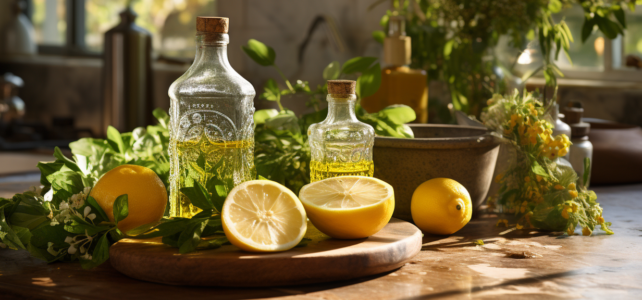
Alcohol vinegar, often avoided in Islamic cuisine due to its transformation from fermented substances, raises questions about its compliance with halal principles. Some Muslim scholars believe that the transformation process eliminates the initial alcohol, making this vinegar acceptable, while others advocate caution, favoring alternatives like date vinegar or cider vinegar. This divergence of opinions reflects the complexity of interpreting Islamic dietary laws and the importance of choosing ingredients that respect both culinary traditions and religious prescriptions.
Alcohol Vinegar in Islamic Cuisine: Between Tradition and Belief
Alcohol vinegar, an acidic liquid composed of water and acetic acid often derived from beet sugar, occupies a gray area within Islamic cuisine. The Muslim tradition, attached to the prescriptions and teachings of the Quran, scrutinizes the nature and transformation of food closely. The Islamic alcohol vinegar, subject to various interpretations, lies at the heart of a debate linking culinary tradition and Islamic belief.
Reference to religious texts, particularly the hadiths, is crucial in understanding the use of vinegar in Muslim diets. A well-known hadith mentions vinegar as a favorable condiment, which could imply acceptance of its use. However, the distinction between different types of vinegar and their production methods prompts careful analysis.
Islamic entities and scholars approach the issue with seriousness. Consider the arguments based on complete chemical transformation, claiming that the original alcohol is no longer present in the final product. This has led part of the community to regard alcohol vinegar as halal.
Another faction remains cautious, highlighting the origins of vinegar and its connection to fermented substances. Islamic belief, in its pursuit of purity and respect for prohibitions, may thus steer towards substitutes such as date vinegar or cider vinegar, which are considered unquestionably halal. This caution illustrates the constant concern for compliance with the Quran’s directives, which advocate the consumption of what is good and pure.
The Status of Alcohol Vinegar in Islam: Analysis and Perspectives
The status of alcohol vinegar within Islamic cuisine continues to spark debates among the faithful and Muslim scholars. The religious analysis of alcohol vinegar, often derived from beet sugar, revolves around the dietary rules established by the Quran and the Sunnah. Sheikh Ali Ferkous, a prominent contemporary scholar, has addressed this issue with a decisive opinion: according to him, vinegar derived from wine, whose transformation is complete, is permissible in Islam. This position reflects an interpretation based on the substantial transformation of the nature of alcohol into a new product.
At the same time, the works of Ibn Qayyim, a scholarly figure in Islamic history, add a beneficial dimension to the consumption of vinegar. His writings highlight the benefits of vinegar, attributing therapeutic properties that strengthen the argument for its inclusion in Muslim diets. These Islamic perspectives, drawn from the richness of historical and contemporary sources, offer a nuanced view that transcends the mere legality of the product to embrace its health virtues as well.
In light of these various insights, the Muslim community is moving towards a pragmatic and informed approach. Consider the Quran, which declares the consumption of what is good as the foundation of this approach. Islamic perspectives on the status of alcohol vinegar thus evolve, integrating both religious considerations and scientific analyses, to guide the faithful towards dietary practices that respect the principles of faith while taking into account advancements in modern knowledge.