Luxembourg attracts more visitors each year, but the average length of stays tends to shorten. This paradox reflects a country often reduced to a one or two-day stopover around the capital, while its rural regions deserve a slower pace. Organizing a stay in Luxembourg without a car requires understanding the actual functioning of the free transport system, its limitations at the borders, and the discrepancies in availability between urban and rural accommodations.
Free transport in Luxembourg: what the network actually covers
Since the introduction of free transport, buses, trams, and second-class trains operate without a ticket throughout the entire territory of Luxembourg. For a traveler staying within the country’s borders, the transport budget drops to zero or almost zero.
The main limitation concerns cross-border trips, which remain paid. A round trip from Metz, Trier, or Liège requires a standard ticket up to the Luxembourg border. First class on CFL trains is also charged. Planning a trip from France or Belgium relying on total fare-free travel leads to an unpleasant surprise at the checkpoint.
Connections between regional bus lines and the capital’s tramway work well during the day, but frequencies drop in the evening and on weekends on certain rural lines. Checking the actual schedules on Travel Guide before setting an itinerary between two regions helps avoid being stuck at a stop without a shuttle for two hours.
Car-free stay between Luxembourg City, Mullerthal, and Moselle
Connecting these three areas by public transport is feasible but requires precise sequencing. Here are the elements to include in the planning.
Luxembourg City as a starting point
The central station serves most national lines. The tram connects Kirchberg (Mudam, Philharmonie) to the city center in just a few minutes. For Grund and the casemates, everything can be done on foot from the plateau.
Two nights in the city allow you to cover the historic center and museums without rushing. The hotel offer is the densest in the country, with prices significantly higher than in rural areas.
Reaching Mullerthal without a car
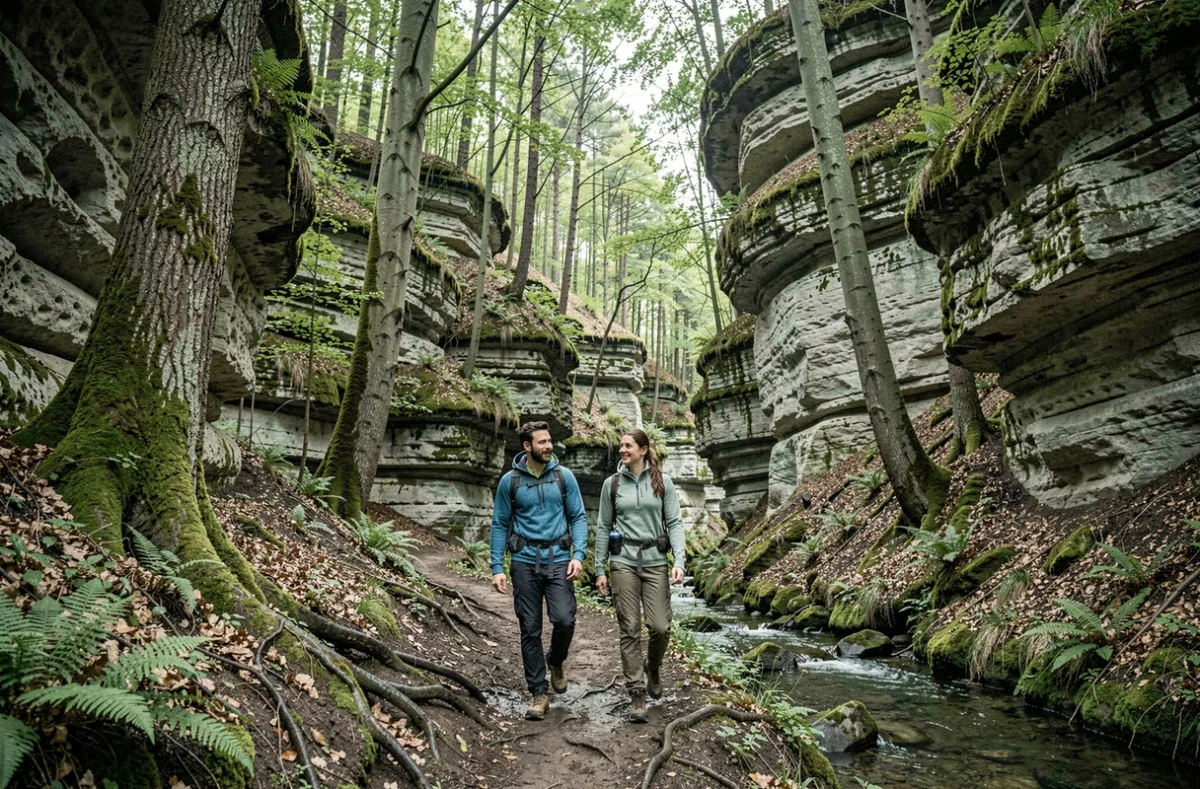
The bus line connecting the capital to Echternach is the most direct means. The journey takes less than an hour. From Echternach, marked trails lead directly from the city center to the rock formations of the Mullerthal Trail.
Accommodation around Mullerthal should be booked early, especially in high season. Options focus on small hotels, guesthouses, and campsites. Camping is indeed a segment that has been growing recently in Luxembourg, which means that even outdoor pitches are not guaranteed without a reservation.
The Moselle, a wine and hiking axis
The Ministry of Tourism promotes the “Wine & Hike” concept along the Moselle, combining walking, scenery, and wine culture. The villages of Remich and Grevenmacher are accessible by bus from the capital, but connections between Moselle localities are less frequent.
Planning an overnight stay rather than a round trip in one day allows you to enjoy the cellars and trails without rushing for the last bus. Accommodations there are often cheaper than in Luxembourg City, with a calmer atmosphere.
Discrepancies between urban and rural accommodation in Luxembourg
The capital concentrates the vast majority of the classic hotel offer. Prices follow a logic similar to other European capitals, driven up by business clientele during the week.
Outside the city, the accommodation landscape changes. Guesthouses, rural lodges, youth hostels, and campsites make up the bulk of the offer. The advantages and constraints differ:
- Rural lodges and guesthouses offer a more favorable price-quality ratio but often impose a minimum stay of two nights in high season.
- Youth hostels (Echternach, Vianden, Beaufort) accept reservations by the night and are well-placed for accessing hiking trails.
- Campsites, which are growing, sometimes offer unusual accommodations (pods, equipped tents) in addition to classic pitches, but their accessibility by public transport varies greatly from site to site.
Checking the bus accessibility of each rural accommodation before booking is a step that many car-free travelers overlook. A lodging three kilometers from a bus stop without a sidewalk or bike path radically changes the experience.
When to go and how long to stay in Luxembourg
The period from May to October offers the best conditions for hiking and outdoor visits. The wine-growing Moselle is particularly interesting in September during the grape harvest.
A stay of four to five nights allows you to combine the capital, Mullerthal, and the Moselle without rushing through the journeys. This format goes against the observed trend (shorter stays), but it better corresponds to the logistical reality of a car-free trip.
Three nights remain a minimum if you want to go beyond Luxembourg City. Below that, the time spent on public transport eats into the time dedicated to visits and hikes.
Preparing a trip to Luxembourg: common blind spots
Several points often go under the radar of classic guides:
- Multilingualism (Luxembourgish, French, German) facilitates communication for French speakers, even in rural areas.
- The hiking trails of the Mullerthal Trail are free and marked, but some sections become slippery and technical in wet weather. Suitable footwear is not optional.
- Parking in the city is expensive and limited, which reinforces the appeal of the car-free strategy, even for those who initially considered a road trip.
Luxembourg remains a country where the density of remarkable sites per square kilometer works in favor of the patient traveler. Extending the stay by one or two nights, choosing rural accommodation accessible by bus, and accepting that some connections require a pause is often what separates a rushed visit from a trip that leaves you with more than just photos of the corniche.