
Between the adjustable clipper and precision scissors, the choice of technique for achieving a sharp pointed beard radically changes the result. The V-shape of the chin requires a level of symmetry that other styles do not demand, and the slightest error of a few millimeters is immediately noticeable from the side. This article compares the tools, techniques, and skin considerations to take into account before getting started.
Clippers, scissors, or razor: a comparison of tools for a pointed beard
Each tool produces a different type of finish on the contour of the chin. The table below summarizes the concrete differences between the three main options.
| Tool | Contour Precision | Irritation Risk | Beginner Friendly | Maintenance Required |
|---|---|---|---|---|
| Clipper with short guard | Medium (depends on the guard) | Low | Yes | Cleaning + oiling the blades |
| Barber scissors | High | Very low | No (technical gesture) | Regular sharpening |
| Razor (straight or safety) | Maximum | High (ingrown hairs) | No | Sterilization, blade replacement |
The clipper remains the most accessible tool for roughing out the general shape. It allows for uniform length reduction before refining the point. The scissors take over for precision work on the chin, where the guard cannot sculpt a sharp V.
The razor is only used to outline the lines of the neck and cheeks once the shape is defined. The American Academy of Dermatology recommends trimming in the direction of hair growth and not pulling the skin to limit the risk of ingrown hairs, which advocates for a gradual approach rather than an immediately very close contour.
To delve deeper into the differences between trimming upwards and downwards, it is useful to trim your beard into a point on Boulevard Mode where both cutting directions are detailed.
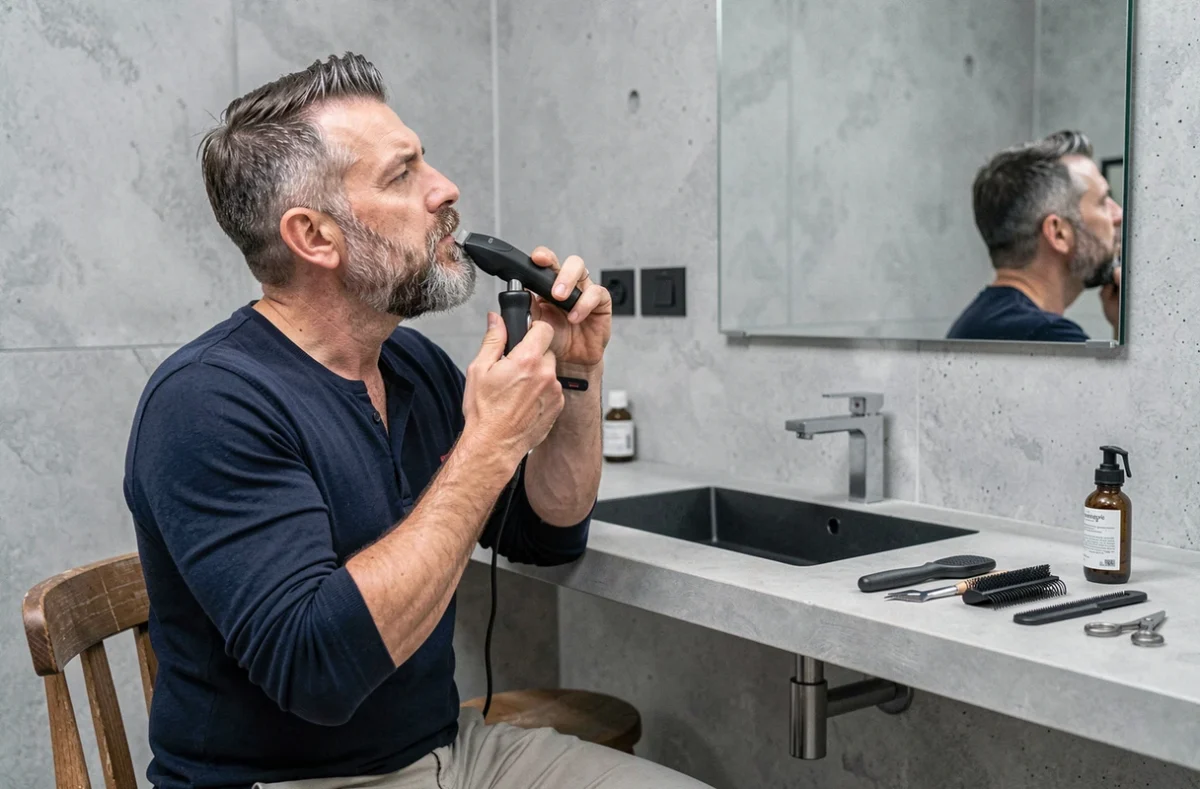
Pointed beard and face shape: rendering differences based on morphology
The pointed beard is not a universal style. Its visual effect varies significantly depending on the geometry of the face, and ignoring this data often produces a disappointing result.
Round or square face
On a round face, the point at the chin visually elongates the oval. This is the scenario where this style works best. The cheeks should be shaved quite short to enhance the vertical stretching effect.
On a square face, the point softens the jawline angle. The trap is to leave too much volume on the sides, which negates the effect and gives an impression of a rectangular beard with a pointed end.
Oval or elongated face
An already elongated face does not need to be stretched further. The pointed beard risks producing a disproportionate effect. In this case, shortening the length of the point and maintaining some lateral volume rebalances the proportions. The ducktail variant (more rounded point, volume maintained on the sides) is often a more suitable compromise.
Step-by-step trimming technique: defining the point without losing symmetry
Symmetry is the main difficulty. Here are the gestures that reduce the margin of error.
- Start with the neck line: place two fingers above the Adam’s apple to locate the lower limit, then shave everything below. This line serves as a stable foundation before touching the chin.
- Rough out with the clipper (medium guard) on the cheeks and sides, intentionally leaving more length at the center of the chin. The V-shape is created by gradual subtraction, not by directly cutting the point.
- Refine the point with scissors: pinch the hairs of the chin between the index and middle fingers, then cut millimeter by millimeter following an imaginary line that goes from the corners of the lips to the bottom of the chin.
- Check symmetry at each step by looking at yourself from the front and at a three-quarter angle. A three-panel mirror eliminates the blind spot of the profile.
Defining the point gradually rather than all at once reduces the risk of having to shorten everything to compensate for an overly aggressive cut on one side.

Winslegue and cheek contour
The winslegue (the line of demarcation between the beard and the neck) plays a structuring role in the final rendering. A winslegue that is too high creates a “floating chin” effect, while a line that is too low gives an impression of neglect that contradicts the precision work on the point.
For the cheeks, the most reliable rule remains to draw a straight line between the bottom of the sideburn and the corner of the lip. Any hair above this line is shaved. This clean contour enhances the V-shape of the chin by creating a clean contrast.
Maintenance of the pointed beard: sensitive skin and product choice
Maintenance determines the longevity of the style between trims. Two to three passes per week with the clipper on the cheeks and neck are sufficient to maintain the contours.
The choice of finishing product deserves special attention. Beard oil softens the hair and makes it easier to comb towards the point. The AAD specifies that acne-prone skin should prioritize a non-comedogenic conditioner rather than oil, which can clog pores and cause breakouts in the chin area, precisely where the pointed beard concentrates the most density.
Persistent itching, flaking, or recurring pimples under the beard do not always stem from a simple dryness issue. The AAD recommends consulting a dermatologist if these symptoms are accompanied by pain or skin lesions, as they may signal seborrheic dermatitis or folliculitis that require appropriate treatment.
- Wash the beard with a gentle cleanser two to three times a week to remove product residue without drying out the skin.
- Brush daily downwards with a natural bristle brush to train the hairs in the direction of the point.
- Apply oil or balm after drying, focusing on the chin area where the hairs are the longest and most exposed to split ends.
The mustache is an integral part of the pointed beard: trimming it to the level of the upper lip with scissors prevents it from distracting attention from the chin line. A fine comb helps to spot any stray hairs.
The pointed style requires regular investment, but the gestures become mechanical after a few weeks. The key is to never correct symmetry immediately after a mistake: it is better to wait a few days for regrowth than to shorten everything and lose the shape.