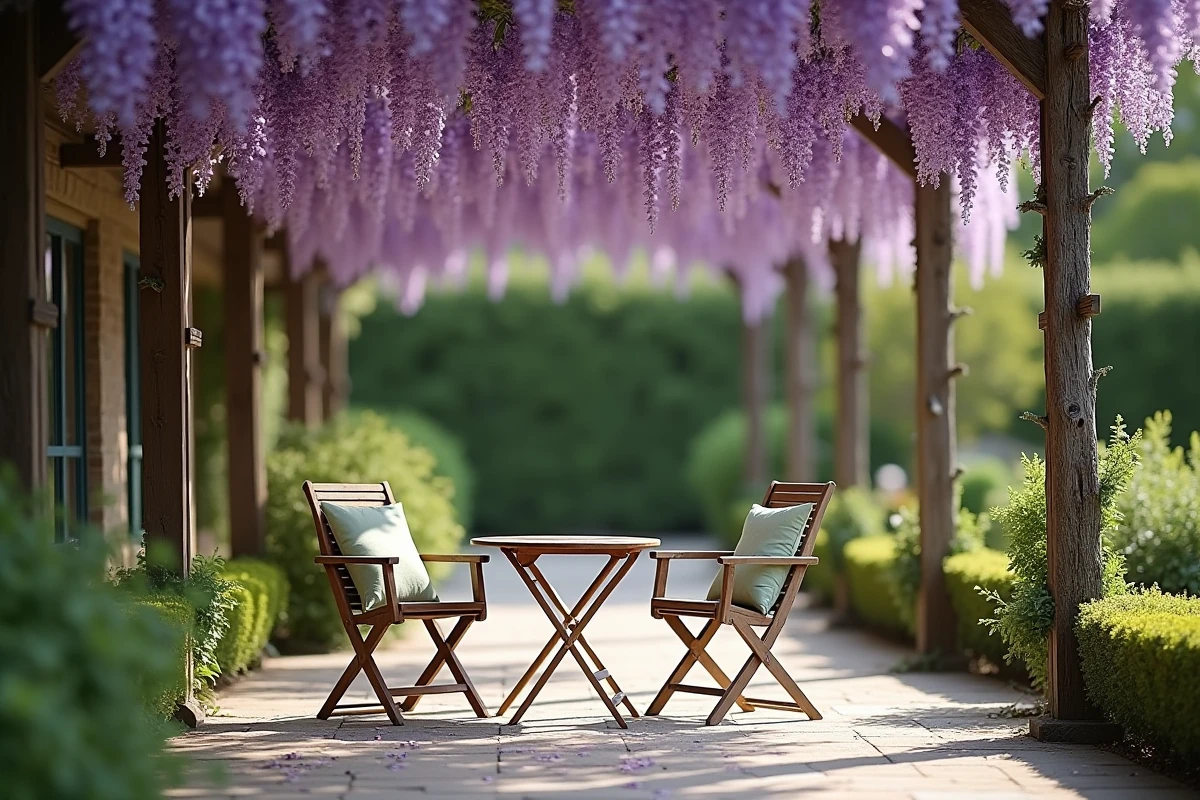
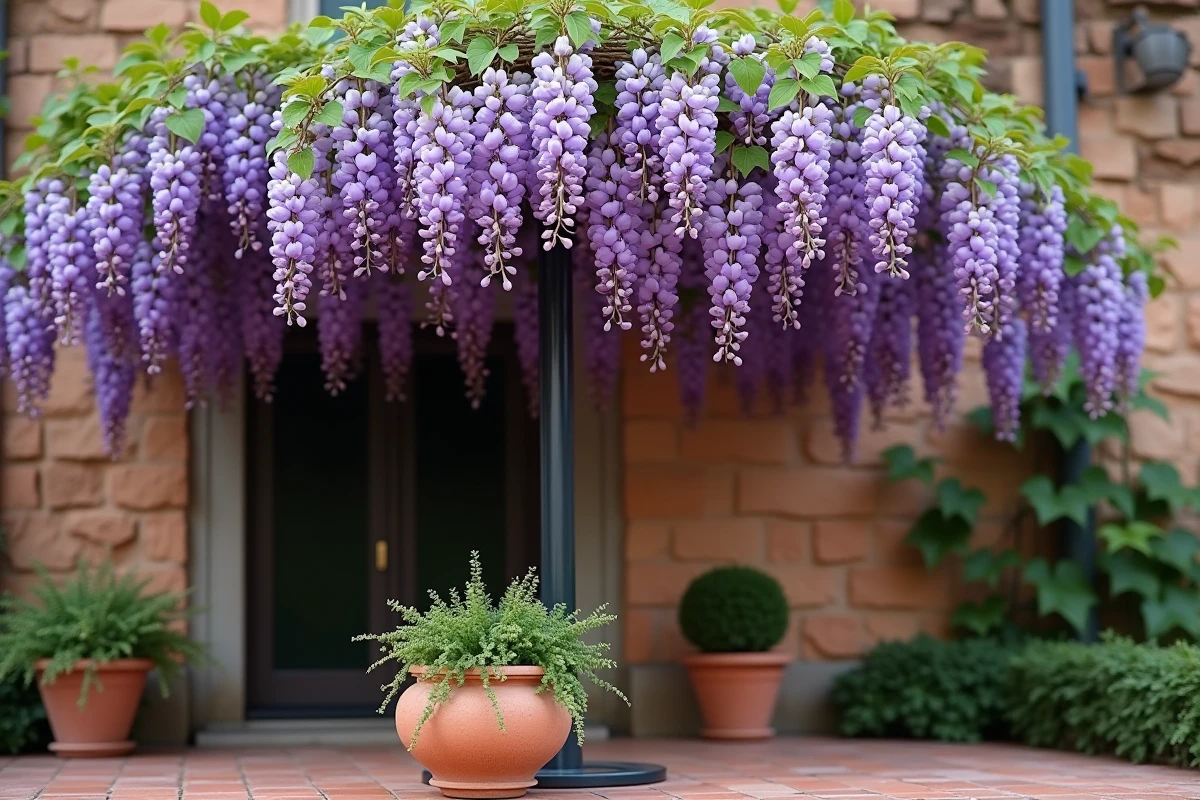
The wisteria trained as a parasol is a horticultural form achieved by training a single plant on a vertical support, then spreading the branches over a horizontal frame. The result produces a dome of foliage and flowering clusters that functions as an autonomous plant shade, without a pergola or masonry construction.
This technique, common in Japanese and Chinese gardens, requires regular pruning work over several seasons before achieving a dense cover. Before projecting onto decoration, it is essential to understand the mechanics of the plant and the constraints of its supporting structure.
Supporting structure and anchoring: the technical basis of the wisteria parasol
A wisteria parasol is not just a pot with a stake. The plant, at maturity, develops a considerable weight of branches. The central post must withstand the lateral pull of the wind on the foliage and the weight of water-laden clusters after rain.
The choice of material determines the longevity of the whole. A galvanized steel post offers the best mechanical resistance. Pressure-treated wood is also suitable, provided a sufficient section is chosen and the condition of the base is checked each year.
The upper frame, shaped like a plate or umbrella, can be made of bent rebar, welded steel tubes, or wooden bands. To learn everything about the wisteria parasol, the logic remains the same: the framework must guide the branches without constraining them to the point of breaking.
The anchoring to the ground deserves special attention. A buried concrete anchoring prevents tipping. In a clay garden, the foundation depth must be adapted to the risk of soil swelling in winter.
Chinese wisteria or Japanese wisteria: choosing the right species for a parasol shape
Not all wisterias behave the same way when trained as a parasol. The two most common species in nurseries, Wisteria sinensis (Chinese wisteria) and Wisteria floribunda (Japanese wisteria), differ on several points that directly influence the outcome.
- Chinese wisteria wraps counterclockwise and produces shorter clusters, but all at the same time. The simultaneous blooming creates a massive visual effect, ideal for a compact parasol.
- Japanese wisteria wraps clockwise, with longer clusters that gradually open from the base to the tip. The effect is more airy, but the blooming is more spread out.
- American wisteria (Wisteria frutescens) remains more modest in vigor. It is suitable for small spaces or potted terraces but produces less dense shading.
For a parasol intended to cover a dining area or garden lounge, Chinese wisteria remains the most frequent choice. Its vigor requires rigorous pruning, but it forms a dense canopy in a few seasons.
Training pruning and maintenance schedule for the plant parasol
The parasol shape is not achieved in one season. The principle relies on a progressive training of the main trunk to the desired height, followed by systematic pinching of the lower lateral shoots to concentrate energy towards the top.
In the first year, the wisteria climbs the stake. The lateral shoots are removed. Only the terminal bud is retained.
In the second year, once the height is reached, the top is pinched to force horizontal branching. The new shoots are guided onto the frame. It is at this stage that the shape begins to appear.
From the third year onwards, two annual prunings become necessary. The summer pruning (July-August) shortens the year’s shoots to five or six leaves to encourage flowering. The winter pruning (January-February) reduces these same shoots to two or three buds.
Without this schedule, the wisteria reverts to a messy vine. The discipline of pruning makes all the difference between a structured parasol and a plant tangle.

Integrating the wisteria parasol into garden and terrace decoration
A wisteria parasol serves as a focal point. Its position in the garden determines circulation, views, and shaded areas. Placing it at the center of a terrace creates a naturally sheltered dining space. Installing it at the back of the garden draws the eye and adds depth to a narrow plot.
The garden furniture placed under the wisteria benefits from remaining understated. A raw wood table, patinated metal chairs, or a stone bench: natural materials extend the plant coherence without competing with the flowering.
Plant associations at the foot of the parasol
The area at the foot of the trunk receives little direct light once the foliage is developed. Shade ground cover plants (heucheras, hostas, variegated ivies) dress this surface without engaging in overly aggressive root competition with the wisteria.
At the edge of the shadow circle, low grasses or lavenders mark the transition with the rest of the garden and provide a textural contrast with the drooping clusters.
Lighting and evening ambiance
String lights wrapped around the frame transform the parasol into a light point in the evening. A spotlight directed at the trunk from the ground highlights the twisted bark, characteristic of old wisteria plants.
Indirect lighting, directed towards the foliage from below, creates a luminous plant ceiling above the table, an alternative to heated parasols or artificial shade sails.
The wisteria parasol requires patience and sustained maintenance, but it produces shading that neither a stretched canvas nor a blind can match. The spring flowering, fragrant clusters, and dense foliage in summer transform a simple corner of the terrace into a distinct space, structured by the living rather than by furniture.